
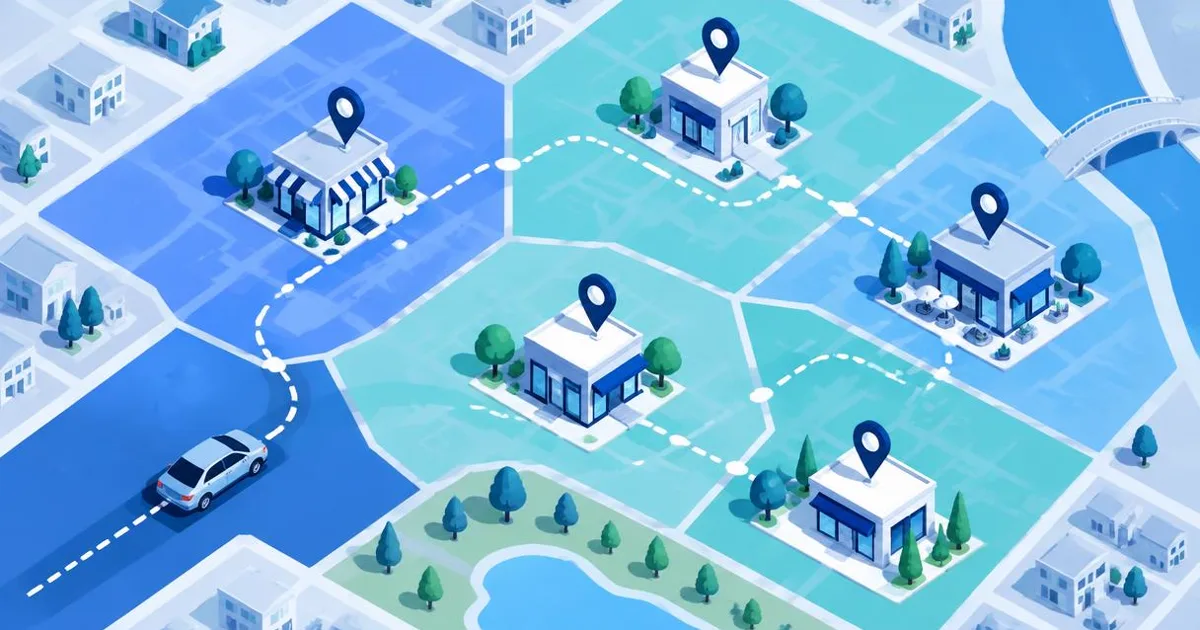
Field sales is a geography problem. Every hour a rep spends driving between scattered accounts is an hour not spent talking to customers. ZIP code targeting is one of the simplest ways to fix that: build prospect lists by ZIP code, group nearby ZIP codes into routes and measure coverage by area.
This guide explains how to use ZIP codes effectively, where their limits are and how to turn a ZIP-based list into a weekly route plan.
Why ZIP codes work for field sales
ZIP codes are familiar, they appear on every business address and most tools understand them. For route planning they offer three practical benefits:
- Compact lists – a ZIP code usually covers a manageable area
- Easy grouping – adjacent ZIP codes can be combined into a day's route
- Simple measurement – you can track how many accounts you have contacted in each ZIP
They are not perfect. ZIP codes are designed for mail delivery, not for sales territories, and their shapes and sizes vary a lot. Rural ZIP codes can cover large areas, while urban ones may be only a few blocks. The Census Bureau's geography program explains how ZIP Code Tabulation Areas approximate postal ZIP codes for statistical purposes, which is useful if you combine your list with public data.
Step 1: Map your territory into ZIP codes
List every ZIP code in your territory. Group them into clusters based on how your reps actually drive, considering highways, bridges and traffic patterns. A cluster should represent roughly one day of visits.
Step 2: Build a prospect list per ZIP cluster
Search each business type you sell to within each cluster. With business leads by ZIP code you can search by ZIP code directly. Every delivered lead includes a business name, phone number and street address, with website and email when available. Because each lead has a real street address, you can plot and sequence stops accurately.
Keep lists the right size
A route list should hold slightly more accounts than a rep can visit in a day, so there are alternatives when a business is closed or the owner is unavailable. If a rep makes ten to fifteen visits a day, a list of around twenty to twenty-five accounts per cluster is a reasonable starting point.
Step 3: Sequence the stops
Within each cluster, order stops to minimize backtracking. Most mapping tools can optimize a route from a list of addresses. Mix existing customers with prospects so the rep is always near a productive stop.
Consider business hours
Sequence by opening hours as well as location. Visit businesses that open early first, and save businesses that open late or are busiest at lunch for the right window.
Step 4: Assign clusters to days
Create a weekly calendar: Monday is one cluster, Tuesday another and so on. Repeat the cycle every two or four weeks depending on how often accounts need visits. Consistent days help customers know when to expect you, which matters for reorders.
Step 5: Measure coverage by ZIP code
Track for each ZIP code:
- Total prospects on the list
- Prospects contacted
- Conversations held
- New accounts opened
Coverage by ZIP shows which areas are under-worked and which are saturated. If a ZIP code has been fully covered with few results, move effort to another area. If a ZIP code converts well, look for adjacent ZIP codes with similar business mixes.
Combining ZIP targeting with business type
The most productive lists combine geography and fit. A beverage distributor might target convenience stores and liquor stores in a cluster of urban ZIP codes, while a janitorial supplier targets offices and gyms in a suburban cluster. Running separate searches by type within the same ZIP codes keeps each rep's day focused.
Using public data to choose new ZIP codes
When expanding, the Census Bureau's County Business Patterns program publishes establishment counts by industry, including ZIP-level business counts. That can help you identify areas with a higher density of the businesses you serve. Treat those counts as context; your own visit results are the better guide.
If you also use direct mail to support field visits, the USPS Every Door Direct Mail service lets you send mail to delivery routes, which can complement a ZIP-based visit plan.
Common mistakes
- Treating ZIP codes as equal in size or value
- Building lists far larger than a rep can cover
- Ignoring traffic and access when grouping ZIP codes
- Not recording visits, so coverage cannot be measured
A sample weekly plan
- Monday – ZIP cluster A: 22 accounts, 8 existing customers and 14 prospects
- Tuesday – ZIP cluster B: 20 accounts
- Wednesday – ZIP cluster C: 24 accounts
- Thursday – ZIP cluster D: 18 accounts
- Friday – follow-ups, phone outreach and planning
Adjust the counts to your rep's real pace after the first two weeks.
Adjusting routes as you learn
Routes should change as you learn. If a rep consistently runs out of time in one cluster, split it; if another finishes early, merge it with a neighbor. Review route performance monthly and rebalance before reps start skipping stops.
Summary
ZIP code targeting turns a broad territory into routes a rep can actually cover. Build compact lists per ZIP cluster, sequence stops by location and hours, assign clusters to days and measure coverage by ZIP code. It is a simple system that keeps reps in front of customers instead of behind the wheel.
You can also build territory lists by state or with the business lead finder.
Sources & further reading
- geography program — census.gov, accessed 2026-10-10
- County Business Patterns — census.gov, accessed 2026-10-10
- Every Door Direct Mail — usps.com, accessed 2026-10-10
External sources are listed for reference. BusinessLeadSearch is not affiliated with these publishers.
Turn this into a prospect list
Build a targeted list with the business lead finder, start from business leads by zip code, or search by ZIP code.